
Our Mission
Win by iterating faster.
Our mission is to design, build, and fly our way to the AIAA Design Build Fly competition in America this coming April.
01Our Plan
Project Daedalus plans to compete at the AIAA Design Build Fly competition by leveraging the expertise of the IDEAL Lab at ETH Zurich to build a machine-learning pipeline for rapid aircraft design and prototyping.
The project explores how tools for parametric UAV generation, automated documentation, simulation, geometry, optimization, and design evaluation can be connected into a practical workflow. The ambition is simple: move from idea to prototype faster, test more options, and make better (and faster) engineering decisions.
02The Competition
The AIAA Design/Build/Fly competition challenges student teams to design, build and fly a radio-controlled aircraft for a new mission every year. For 2026–27 the task is a UAV with a towed sensor: carry it in a shipping container, deploy it in flight, operate it, and bring it back in before landing.
Fly-off
15–18 Apr
Tucson, Arizona
TIMPA
Max wingspan
6 ft
Propulsion energy
100 Wh
-
M1
Staging flight
Three laps without a payload.
-
M2
Delivery flight
Five laps carrying the sensor in its shipping container, plus mock containers of the same size and weight.
-
M3
Sensor flight
Deploy the towed sensor, switch its lights through a set sequence lap by lap, fly as many laps as possible, then stow it before landing.
-
GM
Drop test
On the ground, the container is dropped six times from up to 60 inches (about 1.5 m) and must protect the sensor.
Every flight mission has a five-minute window. The aircraft is electric, propeller-driven and flown manually by radio, with no GPS, no telemetry to a ground station and no assisted take-off. The sensor is at least 6 inches long and towed on a line at least 1.5 times the wingspan.
Official rules and schedule03How We Build a Plane
Every two weeks we run one full cycle, from planning to the analysis of a real flight. Two gates and a go/no-go decision catch faults before the airplane flies, and every flight makes our AI design pipeline more accurate. Select a step to see what happens.
Team
Planning
At the start of every two-week cycle we set SMART goals for the airplane, the software and our teamwork, a time plan with milestones and turning points, clear responsibilities, and a requirement list sorted into critical, major and minor.
AI agents · we approve
Design with our AI pipeline
Our design pipeline uses AI agents to propose and review aircraft configurations. From the design brief, a designer agent proposes changes, our design tools build the aircraft and compute its polars, stability and structures, and a reviewer agent decides whether the design is ready or needs another iteration.
Promising designs get CFD on ETH's Euler cluster (OpenFOAM), but only once we approve the compute hours. A final review then passes or fails the design. People set the goals, approve the expensive steps and do the CAD.
Verification gate 2.1: simulation and physics checks, cross-checked between tools, catch mistakes and AI hallucinations before anything is built.
Team · workshop
Manufacturing
We build one complete airplane per cycle in ETH's student workshop, with 3D printing, a CNC hot-wire foam cutter and a laser cutter.
Test gate 3.1: the built airplane has to match the design in weight, centre of mass and thrust before it may fly.
Team
Briefing
Before the flight test, the team goes through the flight plan, the goals of the test and everyone's role on the airfield.
Decision
Turning point
A go/no-go decision before every flight. On a no-go, the airplane goes back to design instead of risking the flight.
Team
Preflight check
On the airfield we work through our checklists: electronics, controls, centre of gravity and batteries, before the airplane takes off.
Test
Flight test
One flight test per cycle, each an incremental step towards the competition missions: from a safe take-off and landing up to full mission profiles.
Team
Debrief
Right after the flight we record what worked, what didn't and what we learned, while it is still fresh.
AI agents · we approve
Analysis
The flight log is compared with the pipeline's predictions (stall speed, turn radius and more). An analyst agent proposes calibration factors, we approve them, and a MATLAB cross-check and a report-writer agent turn the results into the design report.
This closes the gap between prediction and reality, so the pipeline gets better with every airplane. Then the next cycle starts.
Our tools AI design agents · Euler + OpenFOAM · Fusion 360 · MATLAB · hand calculations · Obsidian
04Our Aircraft
-
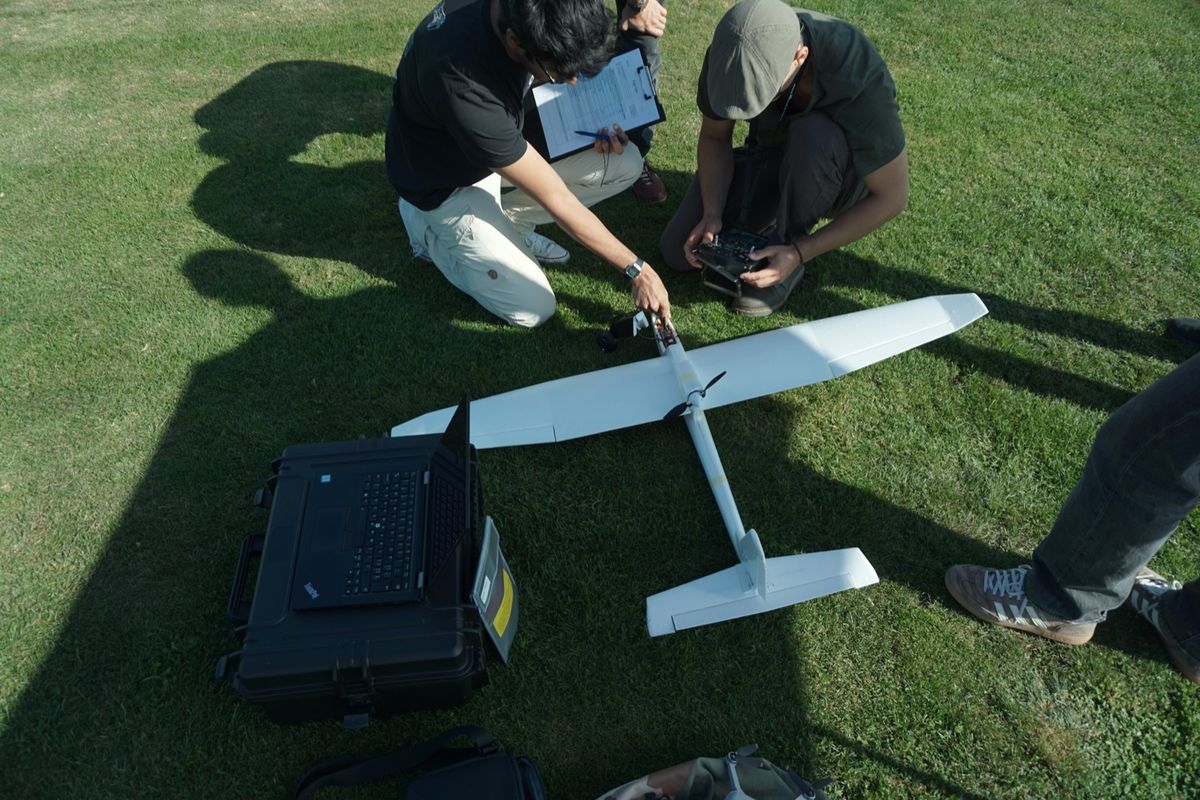
Version 0
Our first prototype. Its first flight tested the whole process, from packing lists and checklists to the airfield.
-
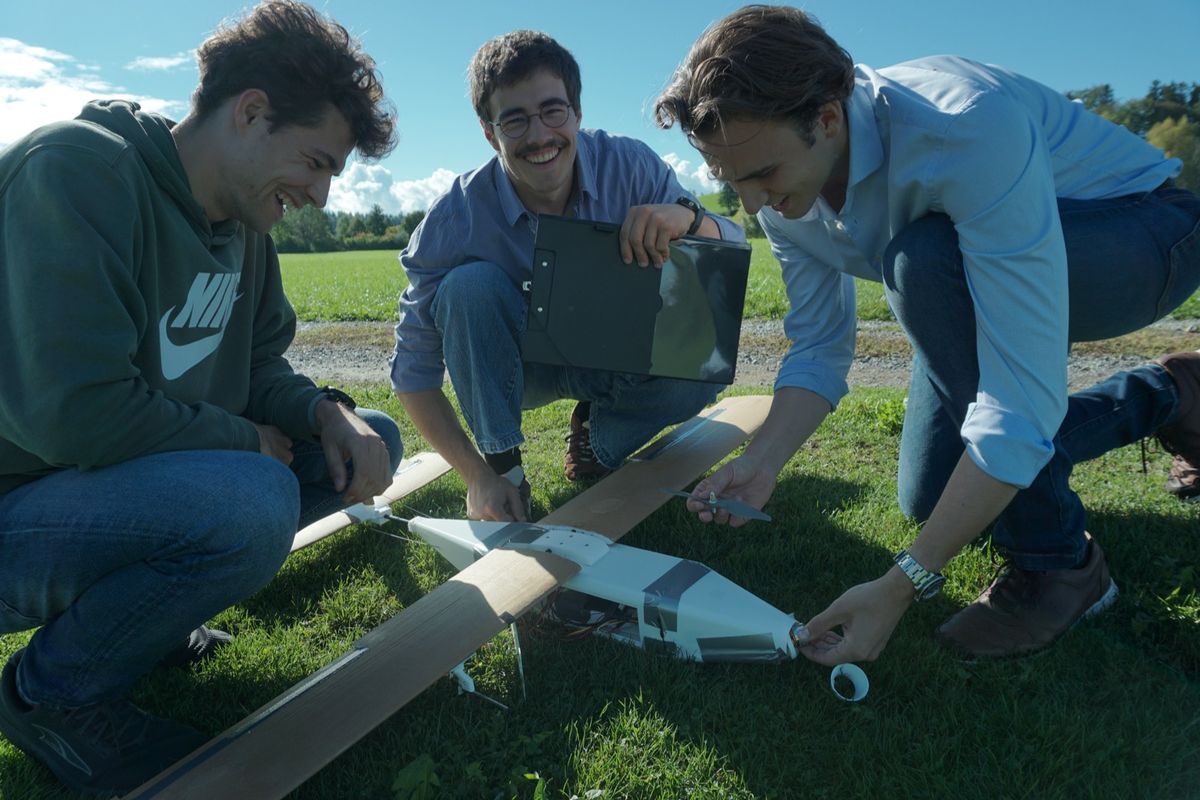
Early wing-test prototype
Built in 8 days to test new wing designs. A short hop showed the motor needed more thrust, a lesson that now shapes every weight budget.
-
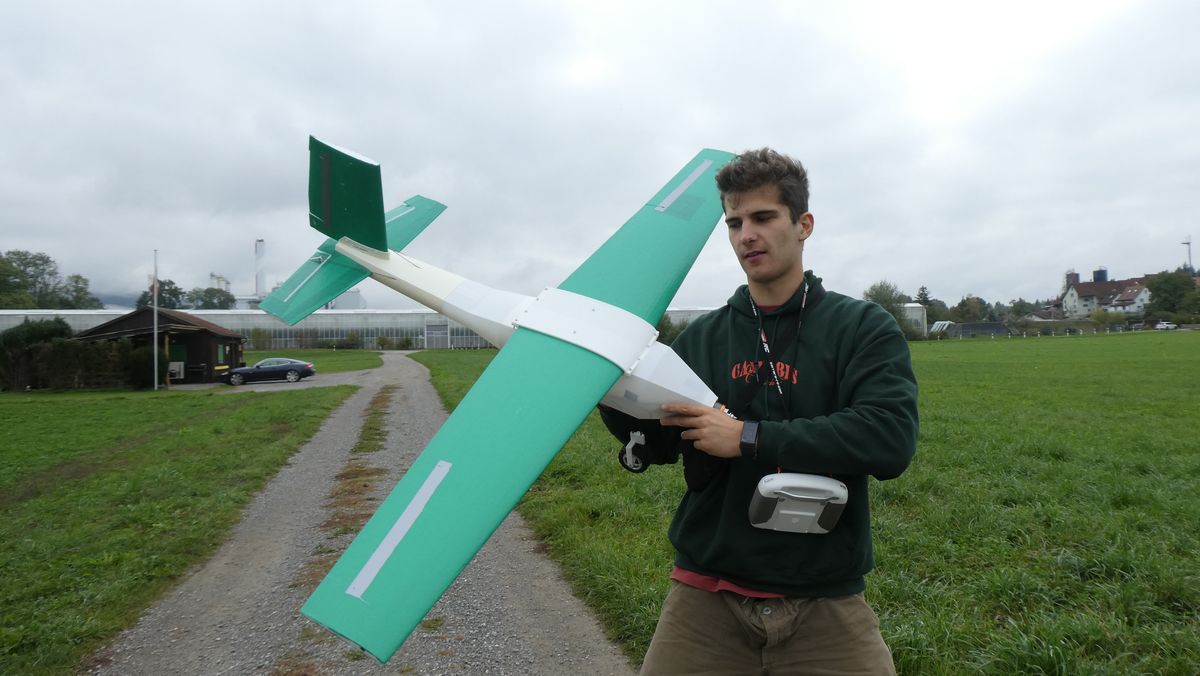
Appenzell
One of our early aircraft designs: built in 13 days, with dihedral wings and a 3D-printed fuselage, and a successful flight.